
How the New Jersey Devils Built an Identity: Urban Roots, the Jersey Devil…
The New Jersey Devils story is a study in reinvention: a relocated franchise that found a regional name, a tight visual brand and a distinctive on-ice style that led to sustained success. This article traces the moves, decisions and eras that fixed the Devils’ identity in modern NHL memory.
Quick answer
The Devils became themselves after the 1982 relocation, adopting a local folktale name and a compact visual mark; strong management and a system-driven coaching era produced three Stanley Cups and a defensive culture centered on Martin Brodeur.
What you will learn here
- Why the 1982 move mattered and how the Jersey Devil name anchored the team regionally.
- How visual identity and colour choices evolved to shape the brand.
- Which management and coaching decisions created the Devils’ defensive reputation and championship runs.
WHERE THE FRANCHISE BEGINS
The franchise that became the New Jersey Devils existed before the move to New Jersey: it played as the Kansas City Scouts (1974–76) and then the Colorado Rockies (1976–82). The club relocated to New Jersey for the 1982–83 season, a structural reset that made a fresh local identity possible.
THE FIRST IDENTITY: NAME AND LOGO
Choosing a team name tied the club to local culture. The New Jersey Devils name references the regional folktale of the Jersey Devil from the Pine Barrens, giving the franchise an immediate, place-based symbol. The primary visual mark that followed—the stylized interlocking "NJ" with devil horns and a tail—gave the team a compact, easily reproduced crest that could carry across jerseys and merchandise.
VISUAL EVOLUTION AND COLOURS
The Devils’ crest and palette were refined over time. Early versions incorporated a red-and-green palette with a green outline, but by around 1992 the green was dropped in favour of black to standardize the team’s look. That simplification tightened the visual identity and made the logo’s devil elements read more sharply on modern uniforms and marketing.
THE ERA THAT GAVE IT REAL SHAPE
Management and long-term direction matter more than a single season. In April 1987 the Devils’ ownership hired Lou Lamoriello as team president (later general manager). Lamoriello’s tenure is widely credited with stabilizing the franchise and assembling the structures—roster construction, scouting priorities and organizational discipline—that led directly to the club’s championship era.
THE SYSTEM: COACHING, THE NEUTRAL-ZONE TRAP AND THE 1995 CUP
On-ice identity coalesced under coach Jacques Lemaire in the mid-1990s. The Devils’ disciplined, conservative neutral-zone defensive system became a defining tactical approach: it prioritized limiting opponent transition through structured positioning. That system was central to the team’s competitive identity and helped drive the 1994–95 Stanley Cup victory.
PEOPLE WHO DEFINED THE FRANCHISE
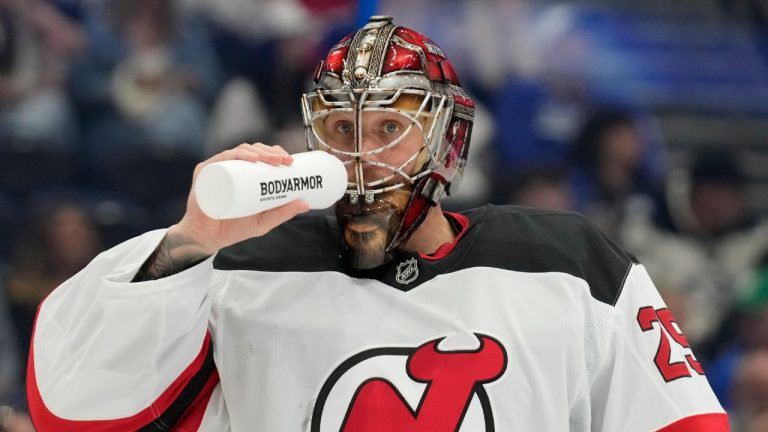
Centrally important figures appear at both management and player levels. Lou Lamoriello provided executive stability and long-term roster architecture. On the ice, Martin Brodeur emerged as the franchise’s defining goaltender across the late 1990s and 2000s, anchoring the Devils’ defensive approach and playing a central role in the team’s championships.
TITLES, THE HIGH WATER MARKS, AND STRUCTURAL SHIFTS
The Devils’ championship record is a clear competitive anchor: the franchise won three Stanley Cups in 1994–95, 1999–2000 and 2002–03. Those titles bookend the era during which Lamoriello’s management, Lemaire’s tactical system and Brodeur’s goaltending converged. The team’s move of home games from the Meadowlands Arena to the Prudential Center in downtown Newark in 2007 is another structural shift: it physically anchored the franchise more directly in New Jersey’s largest city and altered the team’s urban presence.
RIVALRIES, FAN MEMORY, AND CULTURAL WEIGHT
The Devils’ identity is not only trophies and tactics; it rests on place and symbolism. Adopting a local folktale for the team name tied the franchise to regional identity. The simplified horn-and-tail "NJ" mark became an enduring emblem fans could rally behind. The Prudential Center move deepened the club’s urban anchoring, changing how the team related to New Jersey’s civic life and venues.
HOW THE TEAM IS VIEWED TODAY
Viewed through its history, the Devils are best understood as a franchise that engineered stability and a distinct on-ice identity. Relocation created the opportunity, the name and logo supplied the regional brand, and a combination of Lamoriello’s leadership, Lemaire’s system and Brodeur’s goaltending produced sustained success. The Prudential Center era ties that legacy to downtown Newark physically and culturally.
WHAT THE HISTORY REVEALS ABOUT THE NHL
The Devils’ path illustrates several wider NHL truths: relocation can reset a franchise if paired with a place-based identity; disciplined management often precedes competitive breakthroughs; and tactical innovation—here the neutral-zone trap—can define a team’s public reputation as much as individual stars. The Devils show how organizational decisions, visual branding and tactical choices combine to make a modern NHL identity.
WHY THIS FRANCHISE STILL MATTERS
The New Jersey Devils matter because their identity was deliberately engineered across several layers: a local name, a clear logo and palette, a management culture that prized stability, and a tactical system that produced championships. That combination created a recognizable franchise profile—visible in trophies, in the iconic "NJ" crest and in the move to downtown Newark—that remains a useful model for how teams can remake themselves within the NHL.
Author: William L.