Guy Lafleur: From Quebec Remparts Prodigy to Canadiens Legend
Guy Lafleur arrived in the hockey consciousness as a figure of speed and panache: a Thurso-born winger whose junior numbers and effortless skating promised something different for the Montreal Canadiens. His trajectory — from a 130-goal season with the Quebec Remparts to becoming the Canadiens’ all-time points leader — still structures how Montreal remembers the 1970s.
Editorial summary
Guy Lafleur’s career ties a generational junior scoring explosion to a sustained NHL peak: extraordinary junior totals, a No. 1 overall selection for Montreal, multiple scoring titles and Hart trophies, five Stanley Cups, a Hall of Fame induction and later comebacks.
What you will learn here
- How Lafleur’s 1970–71 junior season set expectations that followed him into the NHL.
- Which seasons and awards anchored his dominance in the mid‑1970s.
- How style, production and team success combined to create a lasting Canadiens legacy.
Quick access
Early roots and first hockey development
Guy Damien Lafleur was born on September 20, 1951, in Thurso, Quebec. The clearest early marker of his potential came in junior hockey: with the Quebec Remparts he scored 130 goals in the 1970–71 regular season and finished the year with 209 points. That season — and his role as captain of the Remparts when they won the 1971 Memorial Cup — turned him into a national prospect rather than a regional standout.
The path into higher-level competition
The Montreal Canadiens selected Lafleur first overall in the 1971 NHL Amateur Draft after general manager Sam Pollock engineered a trade to acquire the pick from the California Golden Seals. The selection carried intense public expectation: Lafleur arrived as a No. 1 pick in a franchise still defined by the memories of Jean Béliveau and Maurice Richard, and Montreal fans quickly measured him against those standards.
The Canadiens era that defined him
Lafleur played for the Montreal Canadiens from 1971 until 1985. In that period he recorded 518 goals and 728 assists for 1,246 points with Montreal — numbers that make him the Canadiens’ all‑time leading scorer in club history. He was also central to Montreal’s return to the top of the NHL: the Canadiens captured five Stanley Cups during his tenure (1973, 1976, 1977, 1978 and 1979).
Style of play and on-ice identity
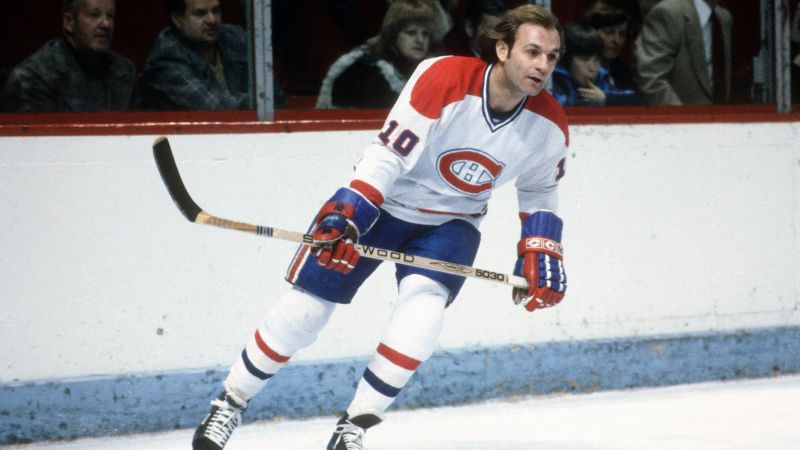
Lafleur’s public image matched his statistical output. Contemporary descriptions and later retrospectives emphasize his blazing speed, smooth, seemingly effortless skating and a creative offensive instinct. He often played without a helmet and carried a flamboyant presence — long blond hair and a confident manner — that reinforced the feeling he brought something theatrical to the ice. In Montreal that translated into a visceral fan reaction: supporters famously chanted “Guy! Guy! Guy!” when he touched the puck.
Peak seasons and records that fixed the legend
The mid‑1970s were Lafleur’s statistical summit. He won the Art Ross Trophy as the NHL scoring leader three straight seasons: 1975–76, 1976–77 and 1977–78. He took home the Hart Memorial Trophy as league MVP in 1976–77 and 1977–78, and was awarded the Conn Smythe Trophy as playoff MVP in 1977. Teammates and opponents also recognized his value: he earned the players’ Lester B. Pearson/Ted Lindsay award for three consecutive seasons (1975–76 through 1977–78).
Those awards came alongside sustained scoring milestones. Lafleur was the first player in NHL history to score 50 goals in six consecutive seasons and he posted six consecutive 100‑point campaigns during his 1970s peak. Together, the trophies, the Cups and the streaks are hard evidence of both individual dominance and a player whose personal peak coincided with team success.
Setbacks, retirement and comebacks
Lafleur initially retired during the 1984–85 season; the Canadiens retired his No. 10 on February 16, 1985. He was elected to the Hockey Hall of Fame in 1988, then briefly returned to play: Lafleur skated for the New York Rangers in 1988–89 and for the Quebec Nordiques from 1989 until his final retirement in 1991. Across his full NHL career he played 1,126 games and compiled 560 goals, 793 assists and 1,353 points.
Guy Lafleur: How he is viewed today
Lafleur’s legacy is measurable in formal honours and in memory. He was inducted into the Hockey Hall of Fame in 1988 and named one of the NHL’s 100 Greatest Players in 2017. The QMJHL retired his No. 4 league‑wide at the start of the 2021–22 season, and he was named a Distinguished Honouree of the Order of Hockey in Canada for 2022. Those recognitions sit alongside the statistical record — the Canadiens’ franchise totals, the Art Ross and Hart trophies, the Conn Smythe and the run of 50‑goal and 100‑point seasons — to explain why Montreal remembers him so vividly.
Lafleur died on April 22, 2022, at age 70, after a nearly three‑year battle with cancer. The combination of his junior breakout, his sustained peak in the 1970s and the cultural imprint he left in Montreal explains the arc of his legend: it is not sustained by affectionate myth alone but by a chain of distinctive facts — extraordinary junior scoring, top draft billing, a unique blend of individual awards and team championships, and visible honours that continued long after he left the ice.
Author: Alex R.