Hockey Wayne Gretzky: Why He Is More Than a Record-Holder
Wayne Gretzky’s name is often reduced to totals: 2,857 career points, a stack of trophies and a shelf of NHL records. Those numbers matter, but they are the visible tip of a larger story. Gretzky’s legacy rests equally on an offensive intelligence and timing that changed how teams attack and how the game is remembered.
Quick summary: Gretzky remains the NHL all-time leader in points (2,857) and held or shared 61 NHL records at retirement. He won nine Hart Trophies, ten Art Ross Trophies and four Stanley Cups with the Edmonton Oilers. This article looks beyond the numbers to explain how his vision, tempo and symbolic presence made him a different kind of hockey figure.
Quick access: What made him feel larger than a player | The playing identity | Visual memory & posters
WHAT MADE THE FIGURE FEEL LARGER THAN A PLAYER
Statistics establish dominance; Gretzky’s totals do more than dominate — they reframed expectation. Being the NHL’s all-time leader in points (2,857) and holding or sharing 61 NHL records at retirement turned individual milestones into cultural reference points. Repeatedly winning the Hart Trophy nine times and the Art Ross Trophy ten times created a sustained pattern: Gretzky was not only the best in single seasons but repeatedly the fulcrum of league storylines.
That repetition matters for legend-making. When a player’s achievements become the standard other players are measured against, the name goes beyond a season or a franchise and becomes a shorthand for excellence itself. Gretzky’s records functioned this way, anchoring debates about greatness and changing how success was defined in the era that followed.
THE PLAYING IDENTITY
Descriptive accounts and contemporary analysis consistently highlight Gretzky’s hockey intelligence, vision and ability to read the play. Those attributes are the practical mechanics behind his production: 894 career goals paired with 1,963 assists show a dual capacity to finish and to create at an unparalleled rate.
His single-season marks — including 92 goals, 163 assists and a 215-point season among his standout campaigns — underline two things: peak explosiveness and an obsessive, repeatable sense of where the game would open. This was less about brute force than anticipation: he often arrived at the productive spot before the defense understood the danger, converting vision into measurable advantage.
ERA, CONTEXT, AND COMPETITIVE IMPACT
Gretzky’s greatest achievements came in a period when the NHL was evolving tactically and commercially. His run of seven consecutive Art Ross trophies speaks to both dominance and consistency across that shifting landscape. Winning four Stanley Cups with the Edmonton Oilers tied his individual brilliance to team consequence — championships that anchored his reputation in playoff success as well as regular-season numbers.
Beyond trophies, his repeated individual awards and the cluster of league records at retirement influenced opponents’ strategies and the way coaches planned for superlative playmakers. The practical effect was to elevate how teams defended, prepared and recruited in response to one player’s sustained advantage.
MOMENTS THAT FIXED THE IMAGE
Certain seasonal peaks and award runs concentrated public memory into durable symbols. Ten Art Ross titles and nine Hart Trophies are not isolated facts; they are a narrative sequence that turned many single moments into a coherent arc of dominance. Those seasonal peaks — recorded in league leaderboards and award lists — became the fixed reference points journalists and historians use when explaining why Gretzky mattered.
Induction into the Hockey Hall of Fame immediately upon retirement and the league-wide retirement of his number 99 formalized those memories. Institutional recognitions convert individual seasons into permanent artifacts of the sport’s history.
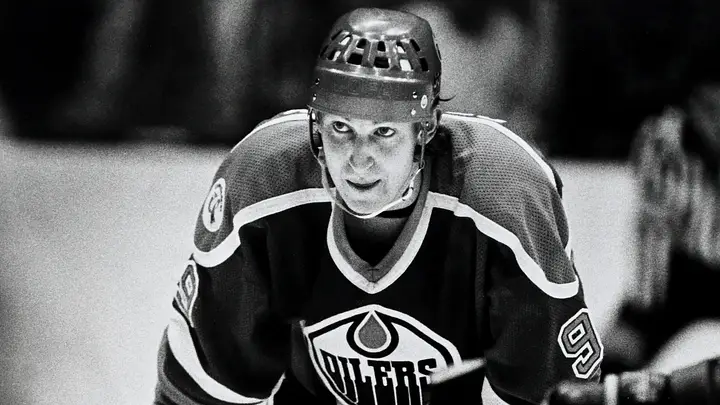
VISUAL MEMORY AND SYMBOLIC PRESENCE
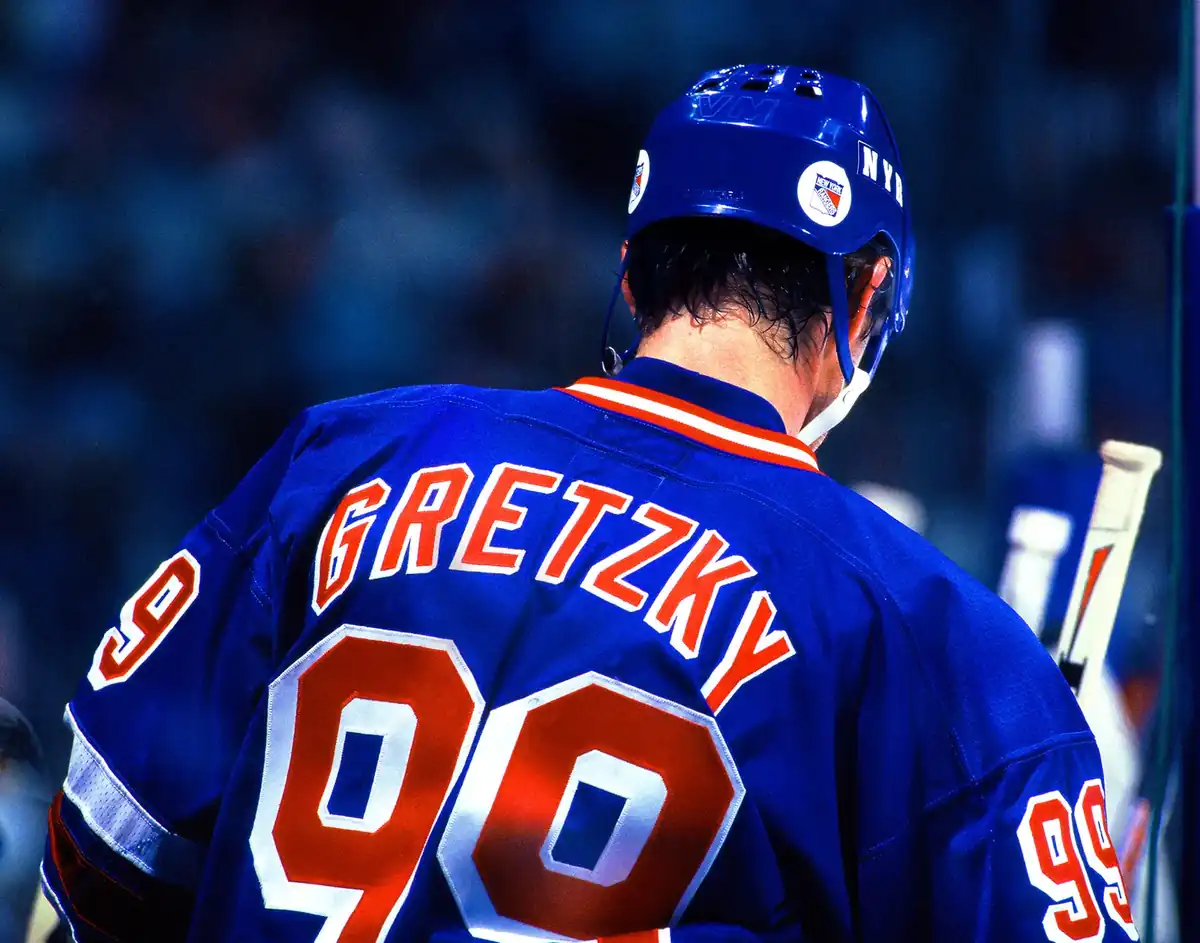
Gretzky’s image translates readily into posters and historic frames because his achievements are both numerically exceptional and visually simple to code: the number 99, the Oilers era photographs tied to multiple championships, and the repeated trophy-lit seasons. When a figure combines clear statistical superlatives with a handful of iconic visual markers, reproductions (posters, features, commemorations) carry immediate meaning beyond the caption.
This clarity helps explain why Gretzky’s image remains a strong presence in hockey culture: his visual shorthand matches the public’s mental shorthand for unmatched playmaking and repeated league leadership.
WHY THE NAME STILL MATTERS NOW
Gretzky’s continuing relevance is twofold. First, the raw records — most notably the career points total of 2,857 — are persistent referents in any conversation about offensive achievement. Second, cultural and journalistic treatments frequently frame him as the archetype for vision-driven play, a narrative supported across reputable outlets and features.
That duality keeps his name active. The numbers invite comparison; the stylistic narrative invites emulation. Together they mean newer generations inherit both a statistical benchmark and a playbook model: what it looks like to build offence around anticipation and tempo rather than only speed or size.
WHAT THE CAREER REALLY REPRESENTS
Beyond a ledger, Gretzky’s career represents a redefinition of offensive possibility. The combination of sustained peak seasons, repeated league-leading campaigns, and team championships provides evidence that his influence was technical, tactical and cultural. He did not simply outscore peers in isolated years; he set patterns other players and coaches had to contend with for decades.
That is the essential difference between a great scorer and a defining legend: Gretzky’s career altered how the game operated and how its history is narrated.
CLOSING INTERPRETATION
Wayne Gretzky’s statistical supremacy is indisputable: career totals, single-season marks and a long list of awards show measurable dominance. But the deeper claim of this article is that his legend rests on how those numbers were produced and how they reshaped hockey thinking. Vision, tempo control and a sequence of peak seasons tied to team success created a legacy that is both quantifiable and culturally durable. That combined evidence explains why the name Wayne Gretzky — and the phrase hockey wayne gretzky — still carries weight beyond the sums on a scoresheet.
Author: Eric M.