Hockey Red Line Explained: What the Centre Red Line Means on the Ice
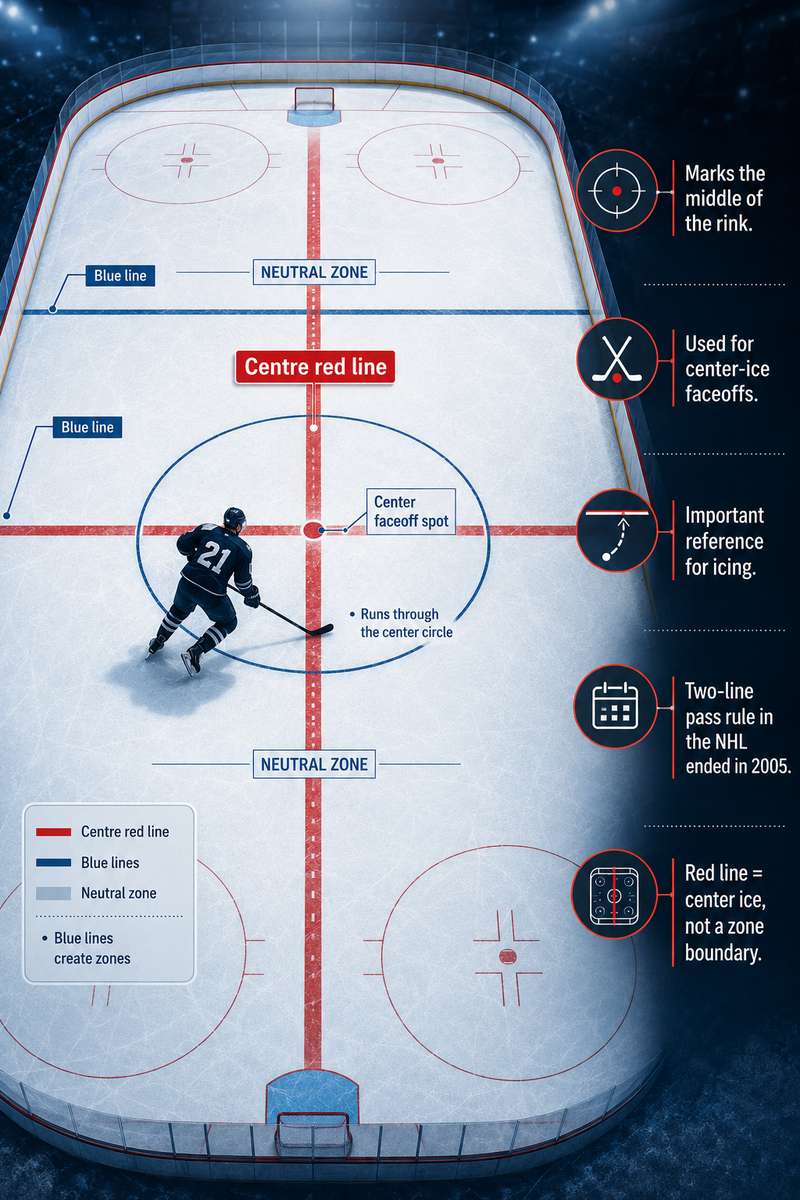
The centre red line is the long red stripe painted across the ice at mid-ice that literally divides the rink into two equal halves. It’s a simple visual marker with practical effects: many rule books use it to define a team’s own half for icing calls, it once played a central role in the two-line pass restriction, and today it remains an essential geographic cue for players, officials, broadcasters and fans.
Quick summary: The centre red line marks mid-ice, helps define "own half" vs "opponent’s half" for icing in many rule sets, was historically tied to the two-line pass rule, and still helps people read rink geography.
Quick access
Definition · How it works with icing · Historical role: two-line pass · Visual and fan value
CLEAR DEFINITION
The centre red line is the painted red stripe that crosses the ice at mid-ice and divides the rink into two equal halves. It is a standard rink marking in IIHF diagrams and other official rink guides and serves as a basic spatial reference for all on-ice activity: offensive zone, defensive zone, and the neutral zone are read relative to that midline as well as the blue lines.
HOW IT WORKS WITH ICING
In many rule sets, including IIHF rules, the centre red line helps define an attacking half and a defending half for the purposes of icing. A common icing scenario is when a player sends the puck from inside their own half and it crosses the opponent’s goal line without being touched; the centre red line is the mid-point that determines whether the puck was played from "own half." Different leagues implement icing differently (touch icing, automatic/no-touch icing, or hybrid systems), but the centre red line commonly appears in the technical wording that separates where the puck was played from and whether icing can be called.
RULES AND OFFICIATING
Rule books that describe icing refer to the centre red line when specifying the origin of the play. Because icing enforcement varies by league, the centre red line’s role is procedural: it is referenced when officials determine whether a puck was shot from a team’s own half. The exact enforcement—whether play is stopped automatically or requires a defending player to touch the puck—depends on the competition’s icing variant, but the mid-ice line remains a foundational marker in that definition.
HISTORICAL ROLE: TWO-LINE PASS
Historically the centre red line was central to the two-line pass rule: passes that originated in a team’s defensive zone and crossed both the blue line and the centre red line to a teammate in the attacking area were once restricted. Leagues such as the NHL removed that two-line pass restriction in rule changes around the 2005–06 era, which reduced the red line’s direct influence on pass/offside decisions. Despite that change, the painted centre line stayed on rinks.
RINK POSITION AND GAME FLOW
Even after the two-line pass rule disappeared in many leagues, the centre red line still divides the neutral zone into two halves. That division matters tactically: coaches and players use it to judge where a breakout originates, where a stretch pass crosses midfield, and how quickly forecheckers can pressure the puck carrier as play moves through the neutral zone. For fans and broadcasters the red line provides immediate spatial context—knowing which half the puck came from clarifies whether a play began near the defending blue line or well inside the neutral zone.
COMMON MISUNDERSTANDINGS
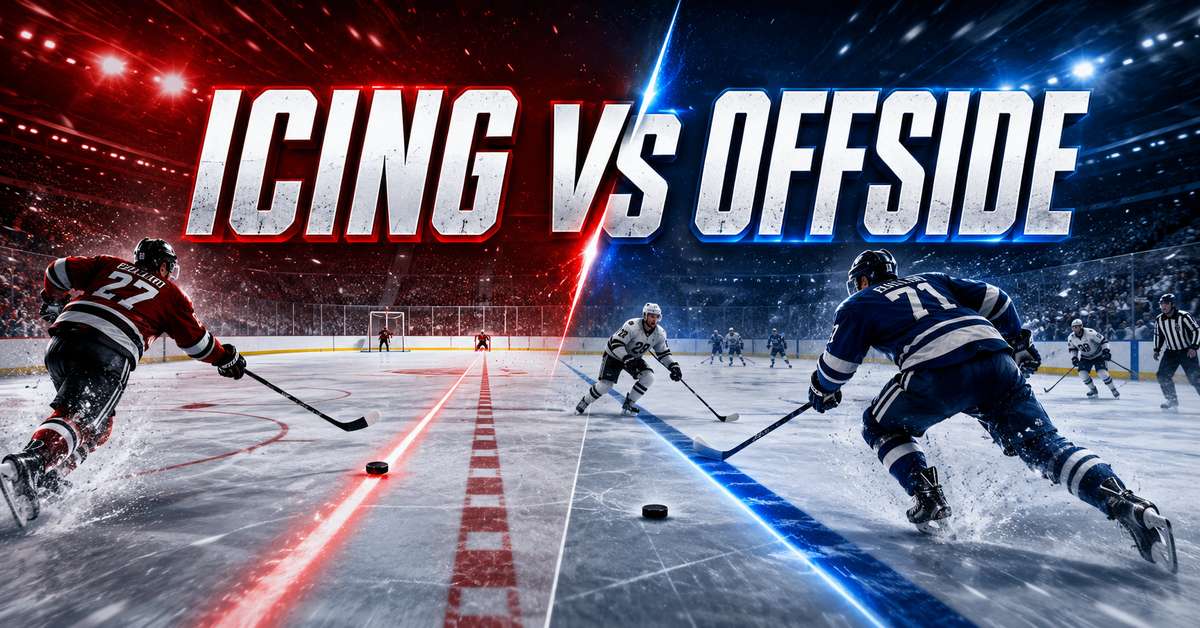
Beginners sometimes think the red line creates an offside or passing restriction by itself; in modern rules it does not create offside the way blue lines do. Its contemporary rule roles are limited and specific—mainly relating to icing definitions—and the two-line pass history can confuse viewers who remember older broadcasts. Remember: blue lines define offside; the centre red line defines halves and historically figured into the two-line pass and icing origin statements.
HOCKEY ART AND VISUAL LANGUAGE
The red line’s graphic clarity has made it a recurring device in vintage hockey posters and wall art. In stylized prints and arena photography, the centre red line often frames player silhouettes, creates symmetry across the composition, and anchors motion from one half of the rink to the other. For collectors of hockey wall art, the red stripe is a familiar motif that signals mid-ice tension—breakouts, neutral-zone battles, and the team identity that emerges when players cross that central dividing line.
CLOSING INTERPRETATION
The centre red line is both literal and symbolic: a simple painted stripe that divides the ice and a rulebook anchor that helps define icing and once helped curb long two-line passes. Today its practical rule role varies by league, but its everyday value is universal—players, officials, broadcasters and fans all use the red line to read rink geography instantly. Knowing what the red line means clarifies why a puck was iced, why a stretch pass mattered historically, and why mid-ice is where so many tactical battles begin.
Author: Alex R.