Icing vs Offside in Hockey: How Each Rule Works and How to Tell Them Apart
Offside and icing are two of the most common stoppage rules in ice hockey, and they confuse new fans because both interrupt the flow but for very different reasons. This guide explains, in plain hockey terms, how each rule works, which rink lines are involved, why officials stop play, and simple ways beginners can tell icing from offside while watching a game.
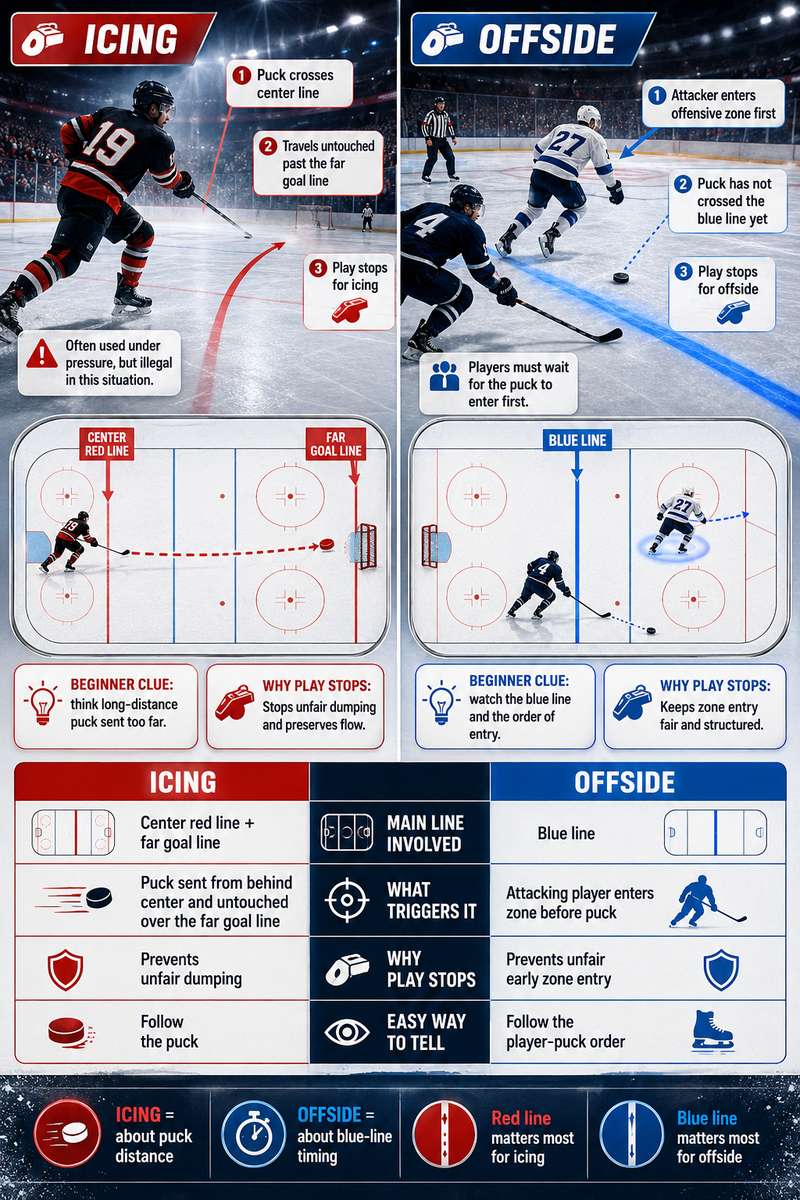
Quick summary: Offside is about the blue line and attacking players entering the offensive zone before the puck. Icing is about a long clear from behind the center red line crossing the opponent's goal line. Both stop play to protect fair competition and safety, but they are judged at different lines for different tactical reasons.
Quick access: Definition · How it works · Comparison
CLEAR DEFINITION
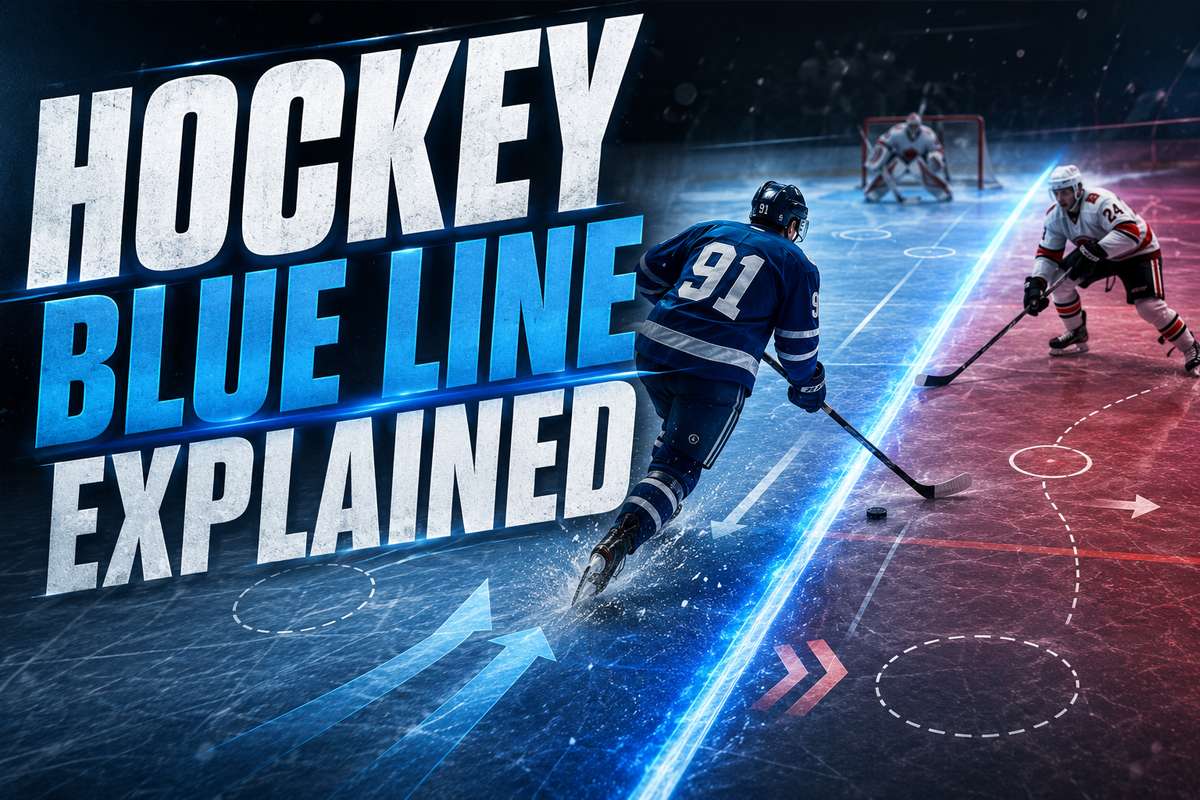
Offside: A positional rule judged at the blue line. An attacking player must not precede the puck into the offensive zone—the puck must cross the blue line before or at the same time as attacking skaters. If not, play is stopped for offside.
Icing: A stoppage called when a player shoots or clears the puck from behind the center red line and the puck crosses the opposing team's goal line. Icing prevents deliberate long clears that would stop play and create dangerous high‑speed chases into the end boards.
HOW IT WORKS
Offside is enforced at each blue line. If an attacking skater is already in the attacking zone when a teammate carries or sends the puck across that blue line, the linesman may call offside. Many leagues allow a delayed offside (tag‑up): the linesman raises an arm and play can continue until offending players exit the zone or the attacking team touches the puck while players remain offside, at which point play is whistled dead.
Icing is measured from the center red line (where the puck is played) to the opponent's goal line (where the puck crosses). Leagues differ in enforcement: touch icing requires an official to reach the puck first to award icing, while no‑touch (automatic) icing blows the whistle as soon as the puck crosses the goal line. The IIHF uses no‑touch icing; other leagues have used touch, no‑touch, or hybrid approaches.
WHY IT MATTERS IN HOCKEY
Offside protects fair entry into the offensive zone and prevents attackers from camping near the opponent's net to gain an unfair positional advantage. It shapes breakouts, blue‑line play, and how teams time entries and line changes.
Icing discourages teams from using safe, long clears as a tactic to stop play and relieve pressure. It also reduces dangerous races to the end boards by eliminating incentives for teams to dump the puck from deep in their own half without consequence.
RINK POSITION AND GAME FLOW
Blue lines mark the defensive/offensive zone boundaries used for offside judgments; the neutral zone sits between them. Offside decisions are about whether attacking skaters cross that blue line before the puck, which directly affects entry timing and forechecking structure.
The center red line and the opponent's goal line matter for icing. A player clearing the puck from behind the center red line that then crosses the opponent's goal line triggers the icing rule (subject to exceptions). That line relationship governs long‑range clearance decisions during breakouts and penalty kills.
RULES AND OFFICIATING
Officials signal and manage both rules distinctly. For delayed offside the linesman raises an arm to indicate play can continue until the offside is corrected. For icing, the whistle is blown when criteria are met (or after an official touches the puck in touch‑icing systems). Rulebooks and video rulebooks provide the exact signals and exceptions used by leagues.
Because leagues vary, the practical enforcement—delayed offside, touch icing, or automatic icing—depends on the competition. In NHL‑style play the official rulebook defines the specifics; internationally (IIHF) no‑touch icing is used.
COMMON MISUNDERSTANDINGS
Beginners often confuse the two because both interrupt play after long passes. The simplest way to tell them apart: ask which line is relevant. If it’s about the blue line and attacking players entering a zone before the puck, it’s offside. If it’s a long clear from behind the center red line crossing the opponent’s goal line, it’s icing.
Also watch the linesman’s arm: a raised arm usually means delayed offside. For icing, the whistle or an official chasing to touch the puck (in touch‑icing leagues) ends the play.
TACTICS AND PLAYER ROLES
Offense and defense structure their entries around the blue line: forwards and defensemen time passes, use controlled zone entries, and use chip‑and‑chase tactics when necessary to avoid offside. Delayed offside gives attacking teams a chance to ‘tag up’—withdraw offending players to the neutral zone so play can continue.
On icing, defensive players and goalies must read whether a long clear risks an icing call; on penalty kills teams balance safe clears with the risk of icing enforcement. Forwards chasing an icing puck must sprint hard to touch it first in touch‑icing leagues, creating dramatic, high‑speed races that icing rules aim to manage or reduce.
HOCKEY ART AND VISUAL LANGUAGE
Both rules appear in game‑day imagery. Vintage posters and wall art often capture the battle at the blue line—skaters packed, sticks up, the tension of a controlled entry—or the wide open neutral zone after a long clear. Posters that celebrate speed and end‑board drama can evoke the chase that icing rules were designed to limit, while classic rink scenes show the blue lines as tactical thresholds in team identity and coaching culture.
CLOSING INTERPRETATION
Understanding icing vs offside makes games easier to read: offside is about fair positional entry at the blue line; icing is about preventing safe long clears from behind center red. Both rules balance tactics, safety, and fairness. Once you watch for the relevant line and the linesman’s signals, these stoppages become logical parts of flow rather than random interruptions—details that also inspire much of hockey’s poster art and rink storytelling.
Author: Eric M.