Hockey Terms Explained: A Beginner’s Glossary of Zones, Positions, Rules and…
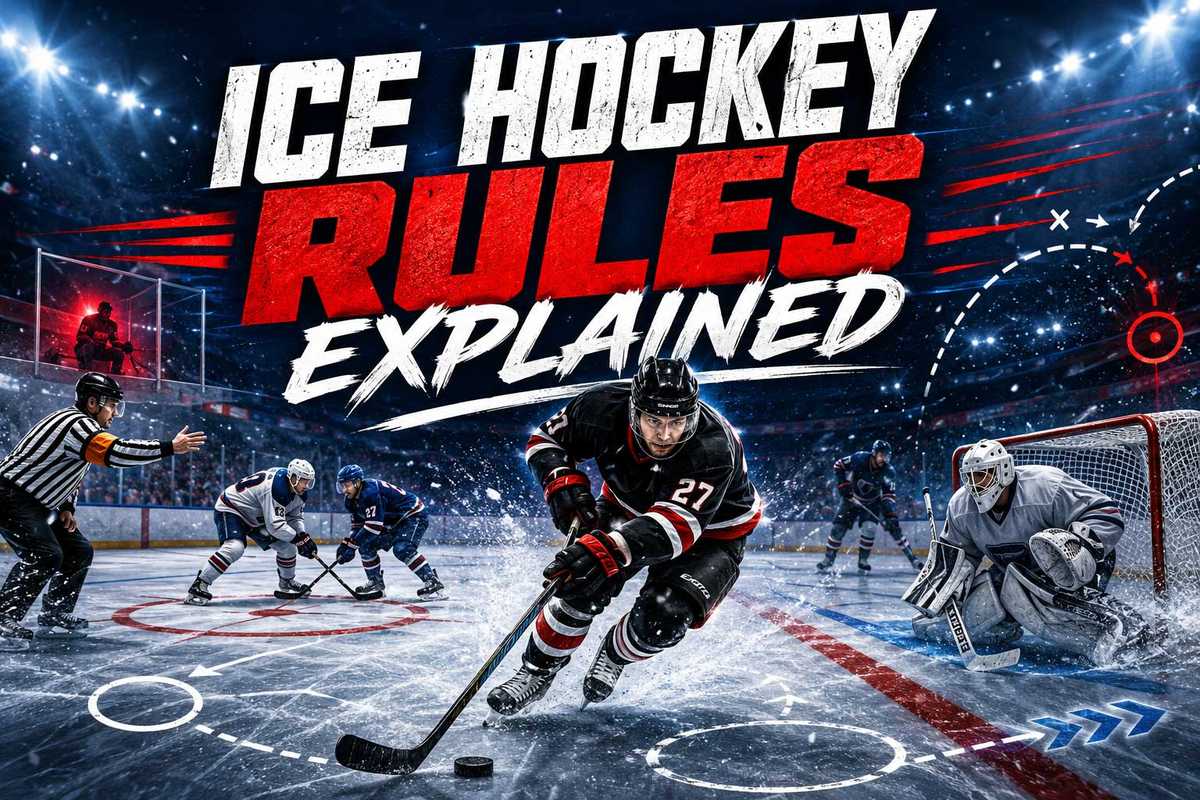
Hockey has its own language: rink geography, player roles, penalties, special teams and broadcast shorthand. This glossary explains essential hockey terms clearly for beginners, adds tactical and rules context for fans, and points out how these elements appear in classic hockey imagery and posters.
Quick summary: A standard rink has three zones. Teams skate with six players on the ice at full strength: a goalie, two defensemen and three forwards (centre, left wing, right wing). Key rules include offside, icing and penalty types; special teams are power play and penalty kill. Common shots and TV terms are also covered.
Quick access: Zones • Positions • Offside & Icing
CLEAR DEFINITION — Rink zones and lines
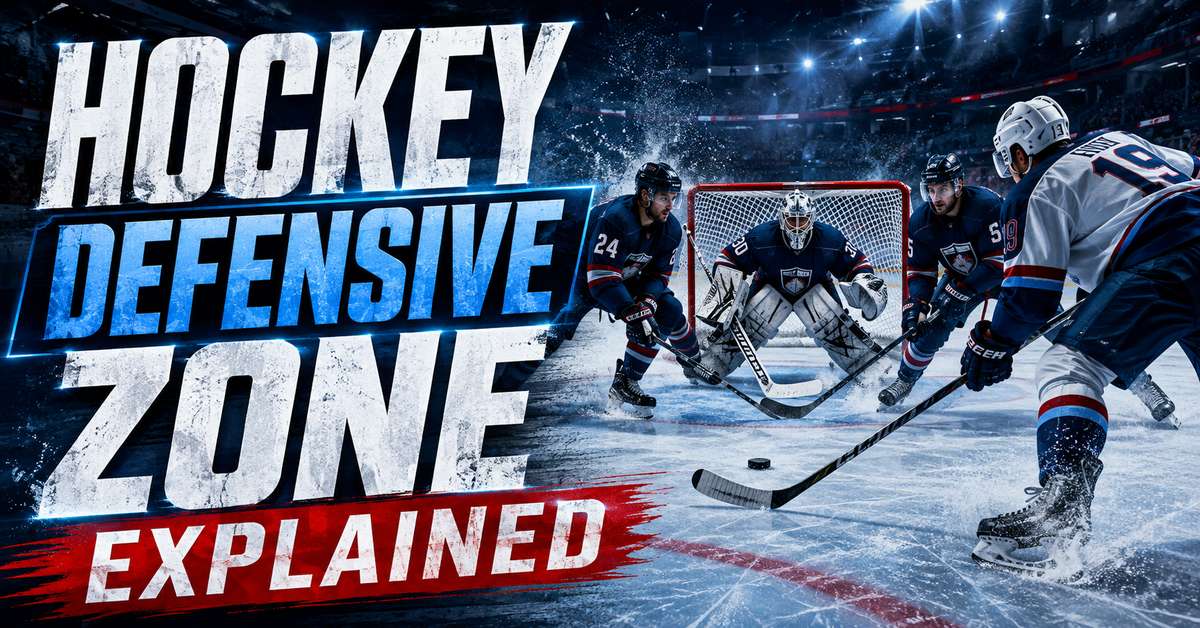
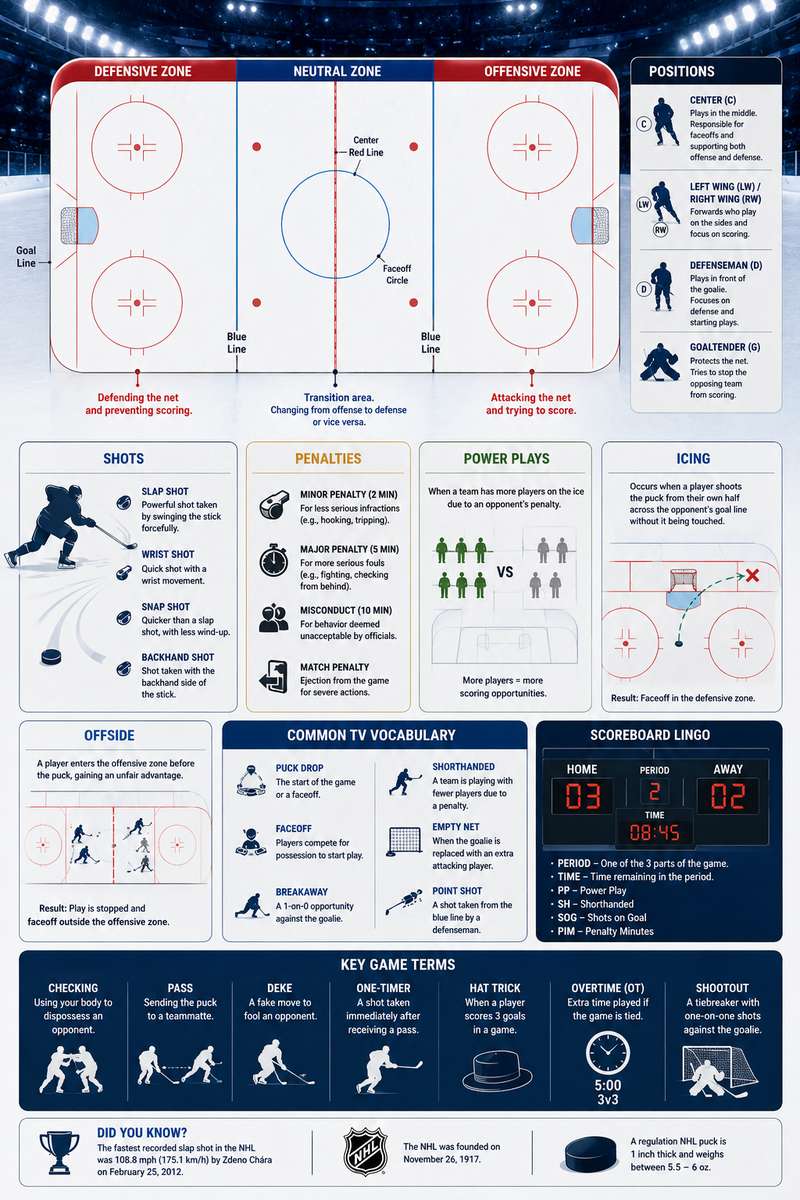
A standard hockey rink is divided into three zones: the defensive zone, the neutral zone, and the offensive (attacking) zone. These are separated by two blue lines and the centre red line. The blue lines mark the boundaries of each team’s offensive and defensive zones; the centre red line divides the ice for icing and faceoff positioning.
HOW IT WORKS — Player positions and typical roles
On-ice structure at full strength normally has six players: one goaltender, two defensemen and three forwards (a centre and two wingers: left and right). The centre usually takes faceoffs and supports both offense and defense. Defensemen protect the defensive zone, move the puck up the ice, and often quarterback the power play. Wingers work the boards and corners, finish plays, and support the centre in the offensive zone.
RULES AND OFFICIATING — Penalties and their categories
Penalties are commonly categorized as minor (typically two minutes), major (often five minutes), misconduct, and match/game misconduct, depending on the rulebook. Typical infractions include tripping, hooking, slashing, charging, high-sticking, interference, and fighting, with fighting usually carrying major penalties in many rule sets. Penalties change on-ice numbers and create power-play opportunities for the non-penalized team.
TACTICS AND TEAM STRUCTURE — Power play and penalty kill
A power play happens when one team has a numerical advantage because one or more opponents are serving penalties; the short-handed team is on the penalty kill. Power-play goals are scored while the advantaged team is on the ice. Teams design set plays, puck movement patterns, and point shots to create traffic and shooting lanes while the penalty-killing team aims to clear the puck, block passing lanes, and limit high-danger chances.
RULES AND OFFICIATING — Offside and icing explained
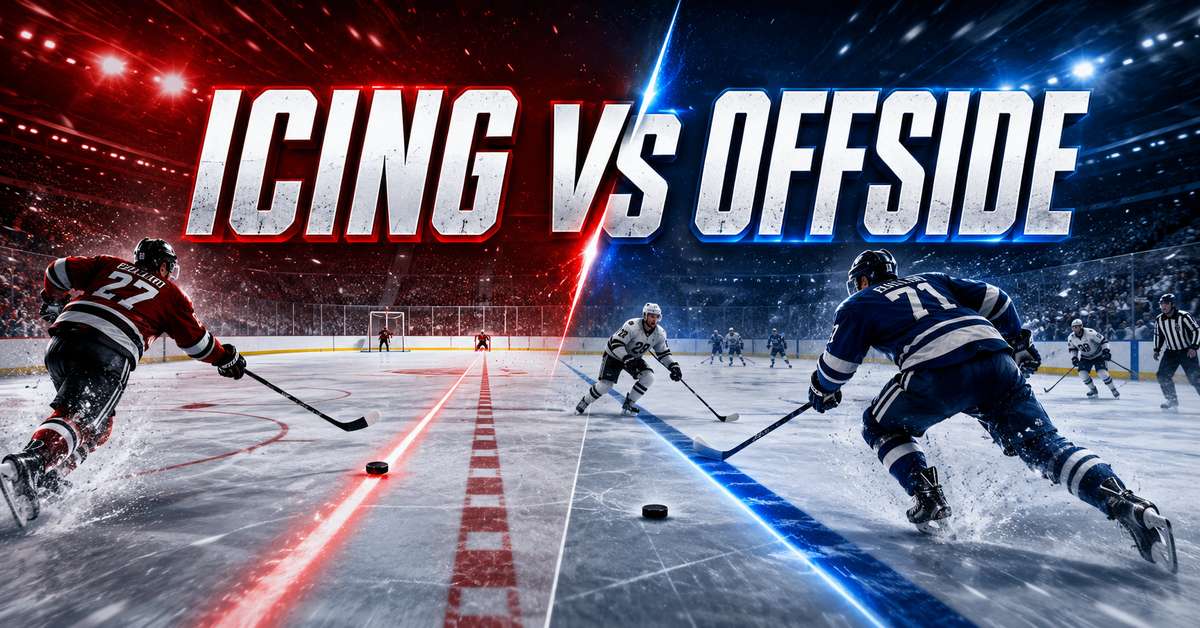
Offside: an attacking player is offside when both of the player’s skates are completely over the opponent’s blue line into the offensive zone before the puck enters. Some competitions allow delayed offside or a tag-up procedure that lets play continue if the attacker exits the zone or re-establishes position as defined by the rulebook.
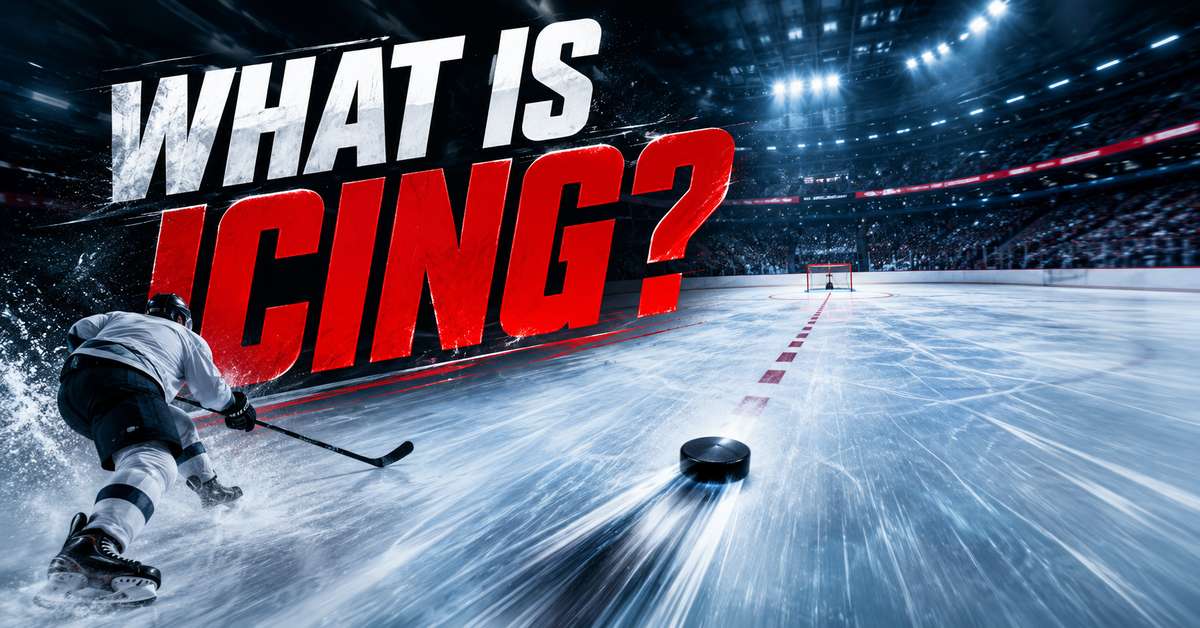
Icing: occurs when a player shoots the puck from their side of the centre red line across the opposing team’s goal line without it being touched. Rulebooks include exceptions and variations: defending-team touch, short-handed play, and different icing procedures such as hybrid or no-touch icing can apply depending on the governing body’s rules.
SKILL NOTES — Common shot types and how they differ
Common shots are the wrist shot, snap shot, slap shot, and backhand. They differ by windup, point of contact, release speed and accuracy. Wrist and snap shots favor quick release and accuracy; slap shots involve a larger windup for power; backhands are less powerful but useful in close quarters. Players choose shots based on angle, time, and traffic in front of the net.
COMMON TV VOCABULARY — Broadcast words fans hear
On TV you'll often hear: faceoff (start or restart of play), hat trick (three goals by one player in a game), empty net (score against a team with no goalie), power-play goal, penalty shot, and save (a goaltender stopping a shot). Recognizing these terms helps viewers follow momentum swings and special-team moments during a broadcast.
FAN VIEWING GUIDE — Where the terms matter on screen
Watch the blue lines and faceoff dots to judge offside calls and zone possession. During power plays, look for the puck-moving defenseman at the point and wingers in the half-boards; on the penalty kill, notice how a defending team compresses the slot and blocks lanes. For icing and line-change context, the centre red line and bench activity tell you when teams are clearing the puck to relieve pressure.
HOCKEY ART AND VISUAL LANGUAGE — How these terms show up in posters
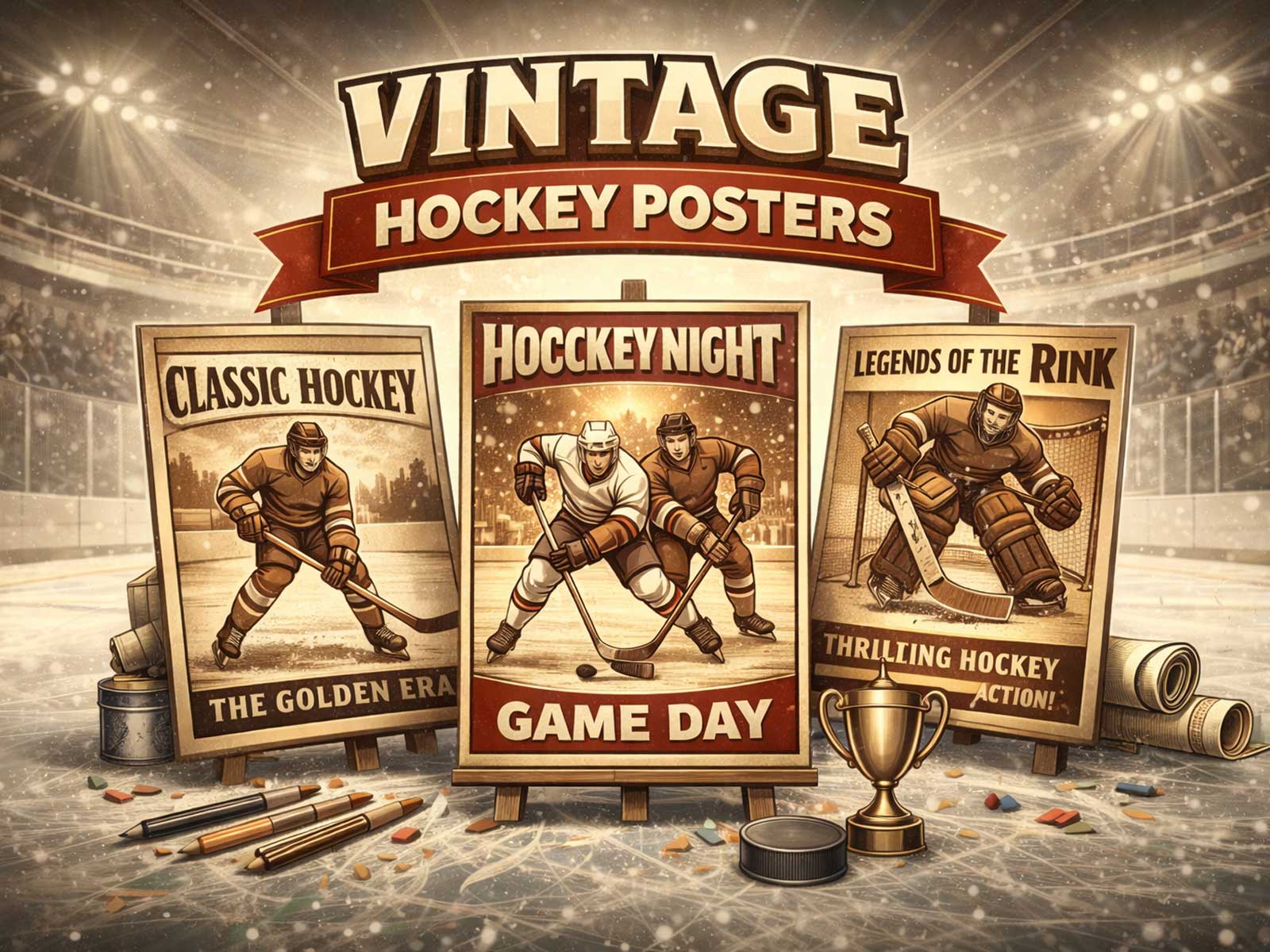
Vintage hockey posters and wall art distill these elements into strong silhouettes: the goaltender in the crease, a defenseman at the point, a centre driving the net, a slap-shot windup, or a goalie save frozen in motion. Rink architecture—boards, blue lines, faceoff circles—gives posters clear graphic anchors that echo the game’s rules and tactics while reinforcing team identity and rink atmosphere.
CLOSING INTERPRETATION
Understanding basic hockey vocabulary—zones, positions, penalties, shots, offside, icing and TV terms—turns moments on screen into clear plays and tactical choices. These building blocks connect skating, puck control, team structure and goaltending to the visual grammar you see in-game and in classic hockey art. Learn them and the game’s flow becomes easier to read, richer to watch, and more resonant with the posters and images that celebrate the sport.
Author: Cynthia D.