Do you have what it takes to be a professional hockey player?
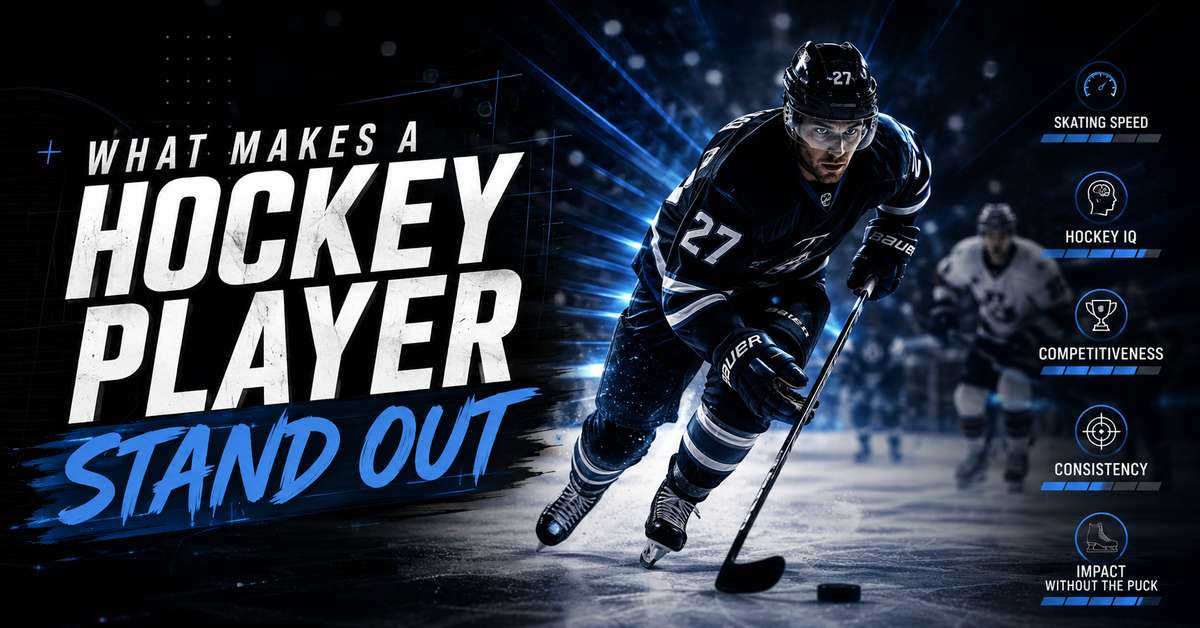
Short answer: maybe — but only if your skating, sport-specific fitness, repeatable competence under pressure, and mental skills reach levels typically seen in elite players. That quick answer hides a much more exacting reality: professional hockey requires not a single super-skill but a combination of physiological capacities, on-ice movement quality, decision speed, and psychological consistency that recreational play usually does not develop.
Quick answer
Reaching professional hockey is possible only when your on-ice movement, repeated high-intensity capacity, strength/power profile and mental readiness meet the multi-dimensional demands that elite teams test and observe; isolated recreational ability is rarely sufficient.
What this article explains
- Why skating and repeated high-intensity capacity are foundations for pro-level play.
- Which measurable physical and mental traits typically appear in elite players.
- How testing and on-ice performance relate — and where evidence is limited.
What the question really means
Asking "do you have what it takes" bundles multiple thresholds into one: the ability to keep up in live match-play, the physiological capacity to repeat intense shifts, the technical skating and puck skills that work under pressure, and the mental skills that stabilise performance. Professional match-play is not a single test; it is high-intensity intermittent work over shifts and games, with position- and role-dependent variation. The literature treats these elements separately (physiology, on-ice external load, psychological traits) because success requires them together.
The early direct answer (evidence in brief)
Research shows professional and college-to-elite players generally present higher-than-average physiological measures (including VO2max ranges reported in reviewed studies) and measurable strength, power, speed and agility attributes. Professionals therefore enter match-play with a physiological and power base geared to repeated accelerations, decelerations and sprinting — capacities that recreational players commonly lack.
Skating as the foundation: why movement quality changes everything
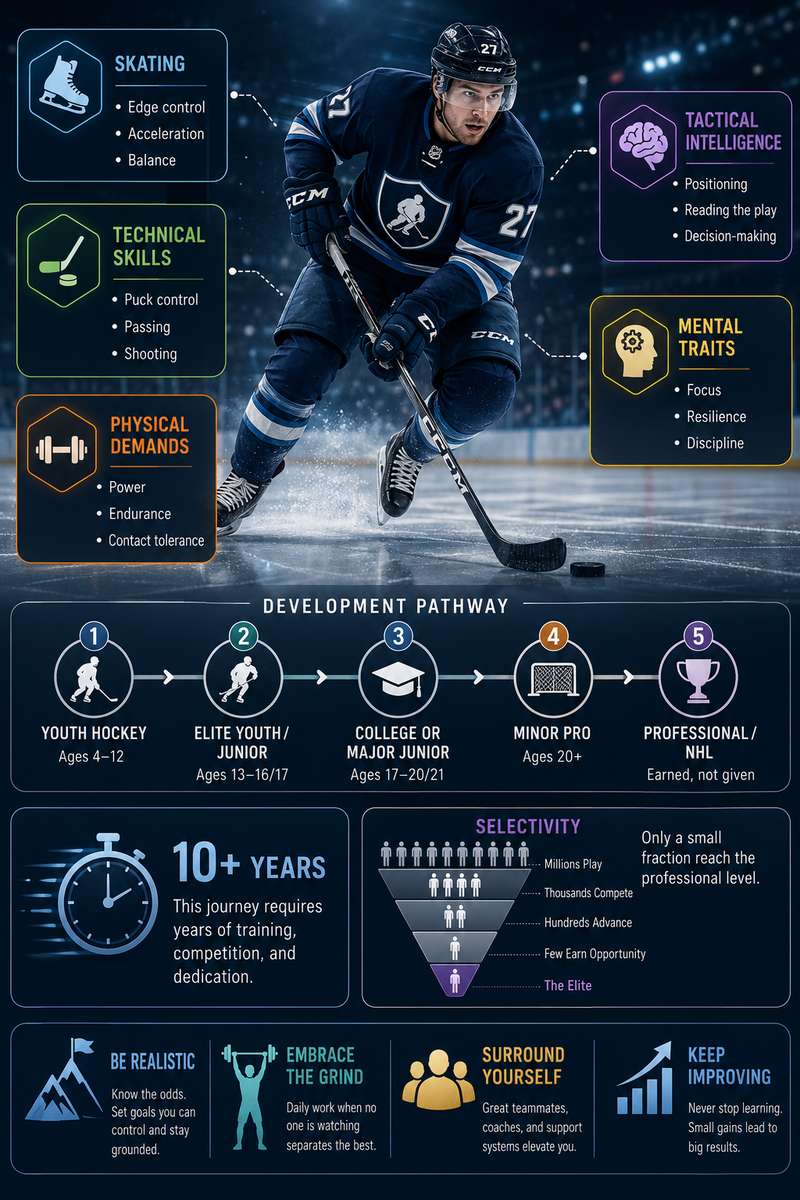
Skating efficiency — clean edges, first-three-step acceleration, stops and transitions — underpins every other hockey action. When skating quality is poor, puck skill, decision-making and defensive positioning collapse under match intensity. Evaluators and conditioning researchers emphasise on-ice external-load measures because the sport’s repeated accelerations and change-of-direction demands require economy of movement; skating is not just speed, it is the ability to produce and recover from short, intense efforts while maintaining balance and puck control.
Physical capacity: what tests tell us and what they don't
Studies and elite test batteries show that professionals typically have elevated VO2max values and superior power/strength profiles compared with recreational players. Professional environments use sport-specific fitness testing (sprinting, repeated-sprint ability, jump tests, agility tests) to profile prospects. However, the research also notes gaps: mapping off-ice and isolated test scores directly to in-game performance remains imprecise. In short, good test numbers help, but they do not automatically prove match effectiveness.
Puck skills at game speed and repeatability
Technical skills measured in drills are necessary but not sufficient. What matters in professional contexts is repeatable execution under fatigue and pressure: receiving and passing on the move, protecting the puck through contact, and shooting or passing with the correct decision in constrained time. Research into external load and match demands emphasises that the body must deliver these skills repeatedly across shifts — not just once in isolation.
Mental skills and performance stability
Mental-readiness traits — focus, commitment, distraction control, positive imagery and resilience — are commonly reported among elite players. These psychological elements are linked to elite performance and matter because physiological and technical skills often fluctuate under fatigue; a player’s ability to reset, learn from feedback, and sustain concentration is part of what separates repeatable professional performance from occasional flashes.
What coaches and scouts actually evaluate
Teams combine physical profiling, on-ice observation and psychological screening. Scouts and coaches look beyond a single highlight: they assess skating economy, first-step acceleration, ability to perform support routes and play away from the puck, decision speed under pressure, and consistency across full shifts. Testing batteries (the kinds used at pro combines) supply additional data — medical, VO2, jumps, agility — but evaluation remains contextual and role-dependent.
Hidden constraints and where evidence is limited
Two important limits stem from the research. First, no single numeric threshold exists that converts an "ordinary" recreational player into a professional; studies provide ranges for elite performers but not a cut-off that guarantees conversion. Second, the term "ordinary player" is undefined in the literature — age, training history and baseline physiology change the picture. Finally, longitudinal evidence tracking recreational players through intensive training into pro ranks is sparse, so we cannot say precisely how many typical adults could bridge the gap given realistic timeframes.
Translating the evidence into realistic pathways
If you are evaluating whether you personally could reach professional hockey, evidence suggests focusing on a few concrete, measurable priorities:
- Skating quality: measurable improvement in acceleration, transitions and edge control that holds under fatigue in full-ice drills and small-sided games.
- Repeated high-intensity capacity: improved ability to perform short sprints and to recover sufficiently between shifts in match-like sessions.
- Strength and power: sport-specific power gains (jump tests, explosive on-ice actions) that translate to board battles and acceleration.
- Mental skills: demonstrated consistency, focus and the ability to process feedback during games and training.
These are the same broad categories that elite testing and on-ice profiling target, but remember: good scores need to translate into full-game influence to matter to coaches.
Ordinary player versus professional player: where most players fall short
What typically overwhelms recreational players first is the combination of repeated intensity and decision speed. Professionals execute technical actions while managing fatigue and reading play in the next one or two seconds; recreational players can perform isolated skills but often cannot sustain edge control, accurate passes or sound decisions repeatedly in a match context. The literature’s emphasis on external-load metrics underscores that the gap is systemic — physiological, technical and perceptual together.
Final verdict: honest, evidence-based
Yes, some players can close the gap — but only by meeting a multi-dimensional set of demands that elite teams measure and observe. Research supports the idea that professional hockey requires elevated physiological capacities (including VO2 and repeated-sprint ability), superior skating mechanics, measurable strength/power, and mental skills for consistency. The science also makes clear there is no single guaranteed threshold, and direct evidence on how many "ordinary" recreational players can make the conversion is limited. For most players, the realistic route is to focus on measurable on-ice skating improvements, sport-specific conditioning, and the ability to reproduce skills in game-like contexts — then let objective testing and consistent full-game performance inform whether pro-level selection is realistic.
Author: Cynthia D.