What Makes a Hockey Player Stand Out? The honest, scout-driven answer
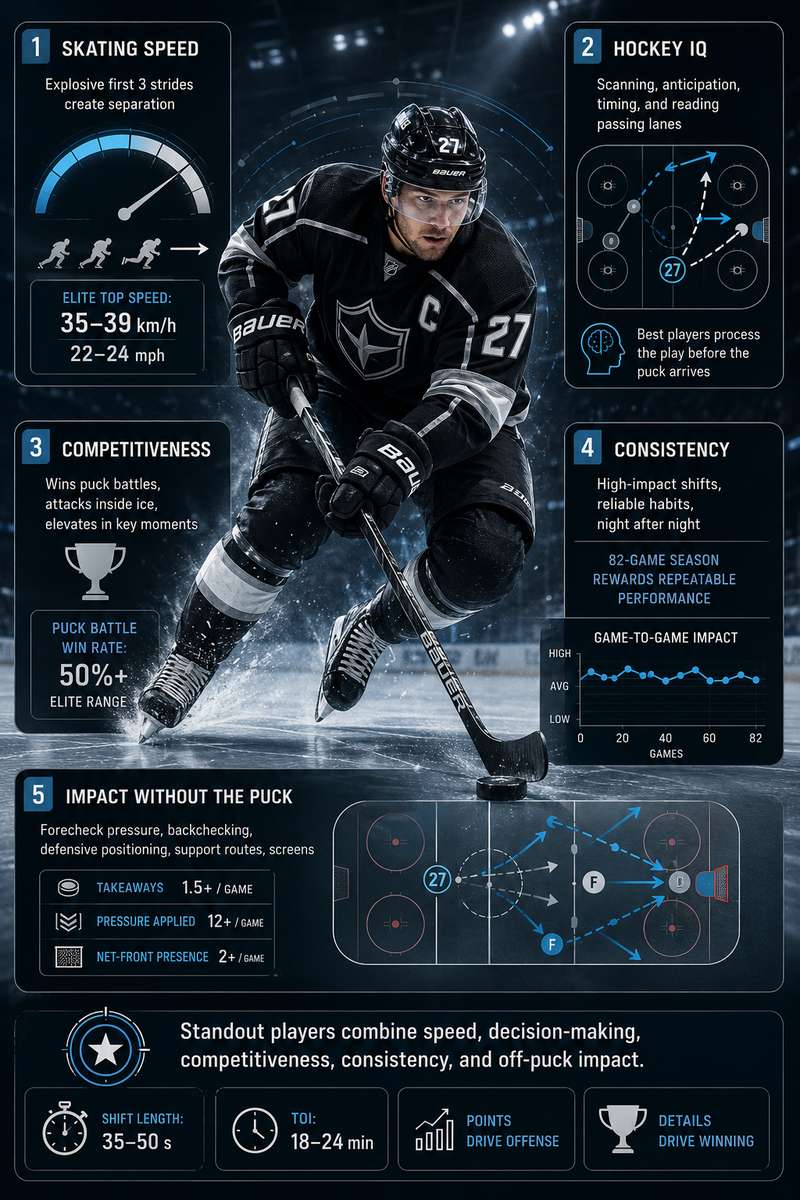
Which single quality makes a hockey player impossible to ignore? Short answer: there isn't one. If you must pick a starting point, skating—speed, acceleration and edge work—shows up first in scouts' and teams' lists. But skating without decision speed, off-puck impact and consistency rarely wins long-term trust.
The rest of the story explains why the visible trait (a highlight goal or blazing speed) is only the doorway. Coaches and analysts now combine on-ice observation with tracking data to separate flashy moments from repeatable, game-changing performance.
The honest answer
Skating is the foundational trait scouts cite most, but true standouts pair skating with high hockey IQ, consistent competitiveness, meaningful off-puck impact and reliable game-to-game production—now measurable and confirmed by modern tracking analytics.
What this article explains
- Why skating is the first thing evaluators notice and how it supports every other skill.
- How hockey IQ and off-puck play convert talent into trusted minutes.
- Why competitiveness and consistency separate prospects during long evaluations.
What the question really means
Asking "what makes a hockey player stand out" mixes two ideas: momentary spectacle and sustained value. Scouts and teams prioritize the latter—players who consistently create or prevent high-value events. Modern evaluation blends eye-test traits (skating, decision-making, competitiveness) with objective measures from tracking platforms that record speed, puck-zone time and shot quality. Standing out isn’t just scoring a highlight; it’s repeatedly changing the next two seconds of play in your team’s favour.
Skating as the foundation: why it comes first
Scouting documents and team reports repeatedly list skating—speed, first-step acceleration, edge control and overall mobility—as the foundational trait. Skating lets a player separate from defenders, recover in the defensive zone, and sustain effective positioning shift after shift. Without efficient skating, puck skills and decision-making tend to collapse under pressure because the player cannot reach or escape contested spaces quickly enough.
Puck skills at game speed: more than tricks
Scouts note stickhandling, passing, shot quality and puck protection as core attributes—but only when executed under real pressure and at game speed. The key distinction: isolated stick skills that look impressive in drills are valuable only if the player uses them to make the correct play in the moment. Passing accuracy while on the move, one-touch decisions under forecheck, and protecting the puck through contact are the practical forms of puck skill that create trustworthy plays.
Scanning, decisions and hockey IQ: the invisible accelerator
Hockey IQ—anticipation, reading plays and making fast, correct decisions—frequently determines who receives more ice time. Players who scan the ice before receiving the puck, who support teammates by moving to useful lanes, and who anticipate opponents’ moves reduce their reaction time and make simpler skills look elite. Teams and a growing body of analysis identify these perceptual skills as decisive because they multiply the effect of every technical ability.
Competitiveness, consistency and impact without the puck
Competitiveness—the willingness to win board battles, pursue 50/50 pucks and forecheck aggressively—turns potential into on-ice value. Equally important is consistency: evaluators reward players who produce reliable performance across games and maintain availability over a season. Off-puck impact (positioning, gap control, and taking away options) is essential for two-way play; it’s the kind of influence coaches demand because it prevents danger as much as it creates opportunities.
Analytics confirm and contextualize observation
Objective tracking now gives teams repeatable measures—skating speed, time spent in offensive zones, shot location data—that correlate with impact. Analytics help separate raw physical traits from useful on-ice effect: a fast player who avoids puck battles or gets caught out of position will show in analytics as limited zone time or negative-impact sequences. Conversely, players who combine tracking metrics with intelligent positioning and competitive play emerge as true standouts.
What coaches and scouts actually evaluate in short sessions and long looks
In a single tryout, evaluators often watch skating posture, first three steps, edge work, ability to receive and make clean passes, and visible engagement in 50/50 plays. Over longer evaluations they add consistency across games, how players respond to coaching, and whether off-puck movement contributes to team structure. Team needs and positional role change emphases—a defender’s gap control and positional reads matter more than highlight goals—so context always shapes the checklist.
Hidden constraints and common misconceptions
Two common errors mislead players and families: overvaluing highlight tape, and assuming one trait guarantees progression. Highlight reels often omit defensive errors, poor positioning, or shifts with no impact. Likewise, possessing one elite trait (e.g., raw speed) does not guarantee a path upward without the decision-making, competitiveness and consistency that make the trait useful in game flow. Tracking data can expose these gaps, so teams now look for the combination of observable skill and measurable impact.
Translating these attributes into real-world progression
If your goal is to be noticed at higher levels, focus on the combinations teams prize: develop skating so you can access plays, practise scanning and anticipation so your decisions buy time, and choose competitions that force you to sustain these skills across full games. Coaches and scouts will privilege players who demonstrate consistent, competitive impact—measurable through modern analytics—rather than those who only flash momentary skill.
Final verdict: the complete formula that makes a player stand out
Standing out is multi-dimensional. Skating is the gateway trait—it enables separation, recovery and the space to make plays—but it becomes meaningful only when paired with hockey IQ, competitiveness, consistent game-to-game production and off-puck influence. Modern analytics now confirm what coaches have long suspected: the players who earn trusted minutes and advance are those who combine physical tools with situational intelligence and repeatable impact.
That combination is rare because each element amplifies the others. Work on skating first, but do so with game-context drills, decision-speed training and competitive habits. The players who look indispensable on a coach’s depth chart are rarely the flashiest—they are the ones who make the right play, in the right place, at the right time, again and again.
Author: Eric M.