Is it too late to become a professional hockey player?
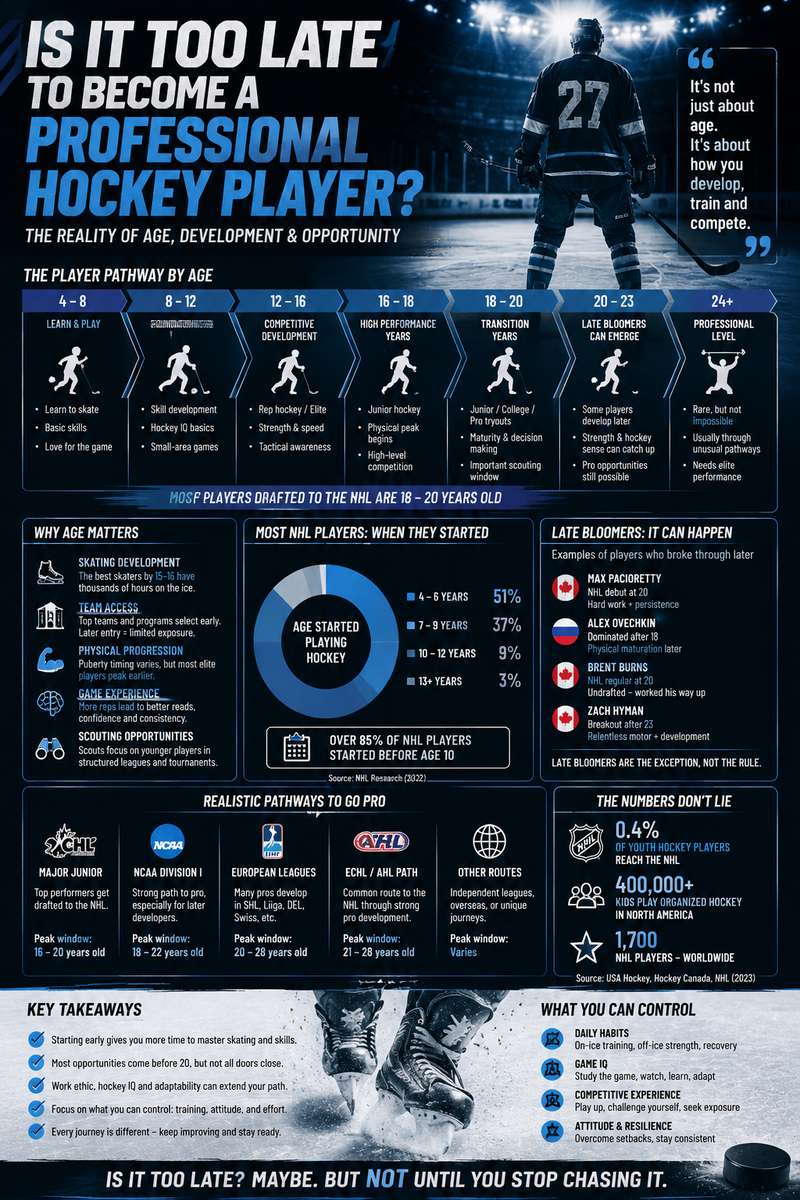
Yes—and no. If your definition of “professional” stretches from lower-tier pro leagues and European clubs to signing an entry-level NHL contract, age matters differently at each step. Early years still shape skating mechanics and game instincts, but structured development models and research on late specialization make clear that starting later does not automatically close every door.
The simple answer is immediate: it isn’t a single cutoff. What changes with age are the opportunities, the visible windows scouts watch, and how much focused training and game exposure you need to catch up. Read on to understand which skills are hardest to retrofit, where visibility narrows, and which realistic pathways remain for later developers.
The honest answer
There is no universal “too late.” Long-term athlete development frameworks do not prescribe a single cutoff age, and many development systems allow later signings; however, earlier skating repetition and teenage visibility windows make the path harder the later you start.
What this article explains
- How age affects skating, physical growth, and the scouting windows that matter.
- Which abilities can be accelerated with deliberate training and which take more time to embed.
- Realistic routes for later developers—college, minor-pro, Europe, and undrafted signings.
What the question really means
Asking “is it too late” bundles several different goals: learning to skate and play well enough for recreational leagues; earning a junior roster spot in your mid-teens; getting a college scholarship; signing any professional contract; or reaching the NHL. International LTAD guidance treats development as phases rather than a single deadline. So the right answer depends on which finish line you mean.
The early direct answer
Early foundations matter because repeated skating and game practice in childhood build technical fluency and perceptual patterns that are costly to recreate later. Yet sports science reviews also show late specialization—diverse early sports then focusing later—can produce elite athletes. Practically: if you entered organized hockey very late, your route will likely shift toward pathways that routinely sign overage or undrafted players, and you must accept a steeper catch-up curve.
Skating as the foundation
Skating mechanics are the primary limiting factor when someone starts late. Edge control, first-three-step acceleration, stops and re-acceleration, and transition efficiency underpin everything a scout values. LTAD frameworks emphasize staged skill acquisition for skating because efficient movement compounds—good edges create time for puck skills and decisions; poor skating makes even excellent stickhandling collapse under real-game pressure.
Age and development timing
Development is a multi-year process. Early repetitive skating experience compounds into automatic movement patterns; physical attributes such as strength and power often continue to mature into the early-to-mid 20s and can be improved with age-appropriate conditioning. However, scouting and selection activity concentrates in mid-to-late teenage windows, making visibility harder for late starters—although pathways exist for those who develop later.
What coaches and scouts actually evaluate
Evaluators look beyond isolated skills. They value skating economy and decision speed, plus the ability to perform those skills reliably across full games. Because early visibility windows exist (national programs, major junior exposure), scouts often prioritize players who displayed sustained performance through those ages. That said, many organizations also sign standout overage performers from college, minor-pro, or European leagues—so later excellence in real competitions still attracts attention.
Realistic pathways for late developers
The verified evidence shows several credible routes remain for players who mature or emerge later. College hockey, minor-pro leagues, European professional clubs, and undrafted free-agent signings are routinely used by organizations to add talent outside the draft window. That means a player who was not in a major junior pipeline at 17–18 can still become a professional if they achieve demonstrable game impact and physical readiness later on.
What can be developed — and what is costly to change
Trainable: strength, power, conditioning, tactical systems understanding, structured puck-practice, and many technical skills. LTAD and S&C position statements support progressive, age-appropriate programs that increase physical capacity into the early 20s.
Harder to retrofit: deeply embedded skating motor patterns and intuitive game timing that comes from thousands of on-ice repetitions in real games. These create the automatic responses scouts use to separate prospects. Re-teaching skating is possible, but it consumes time that could otherwise be spent gaining competitive minutes and exposure.
Scouting opportunities and visibility
Scouts concentrate resources where talent pipelines feed rosters—certain age ranges, major junior circuits, national development programs, and college showcases. This concentration raises the bar for late entrants who lack those exposures. Still, standout performance in college, minor-pro, or European competition is scouted; organizations use these leagues to find overage or undrafted talent. The practical implication: later developers must earn visibility through convincing, consistent game impact at levels that scouts watch.
Hidden constraints and common misconceptions
One famous late-developer story does not generalize. Many readers assume a single skill or highlight reel will change a scout’s mind—scouts instead differentiate between one-off plays and full-game influence. Another misconception is that signing a camp invite equals a roster spot; selection windows are narrow, and camps are one step among many. Finally, paying for an academy or a camp does not guarantee selection; research emphasizes quality coaching and cumulative competition exposure, not simply expensive inputs.
Realistic next steps if you start late
If you are serious and starting later, aim your short-term goals at gaining measurable game exposure and demonstrable physical progress. Seek age-appropriate, sport-specific coaching and progressive conditioning programs consistent with LTAD guidance. Target competition levels where scouting occurs—college leagues, reputable minor-pro teams, or national-level competitions in your region—and build a performance record there rather than chasing singular showcases.
- Prioritize consistent game minutes and full-game performance over isolated drills.
- Follow progressive strength and conditioning plans to develop late physical gains safely.
- Choose competitions known to attract scout attention for your region and level.
Final verdict
It is not categorically too late to become a professional hockey player, but the path narrows as age of specialization or entry increases. LTAD frameworks and sports science confirm that later specialization can lead to elite outcomes, and professional organizations routinely sign overage or undrafted players from college, minor-pro, and European leagues. The realistic test for a late starter is whether they can attain the skating, repeated game performance, and physical readiness that attract scouts—quickly enough to win roster opportunities in leagues that actually scout later developers.
Author: Cynthia D.