How to Become a Professional Hockey Player: The Real Path from Learn‑to‑Play…
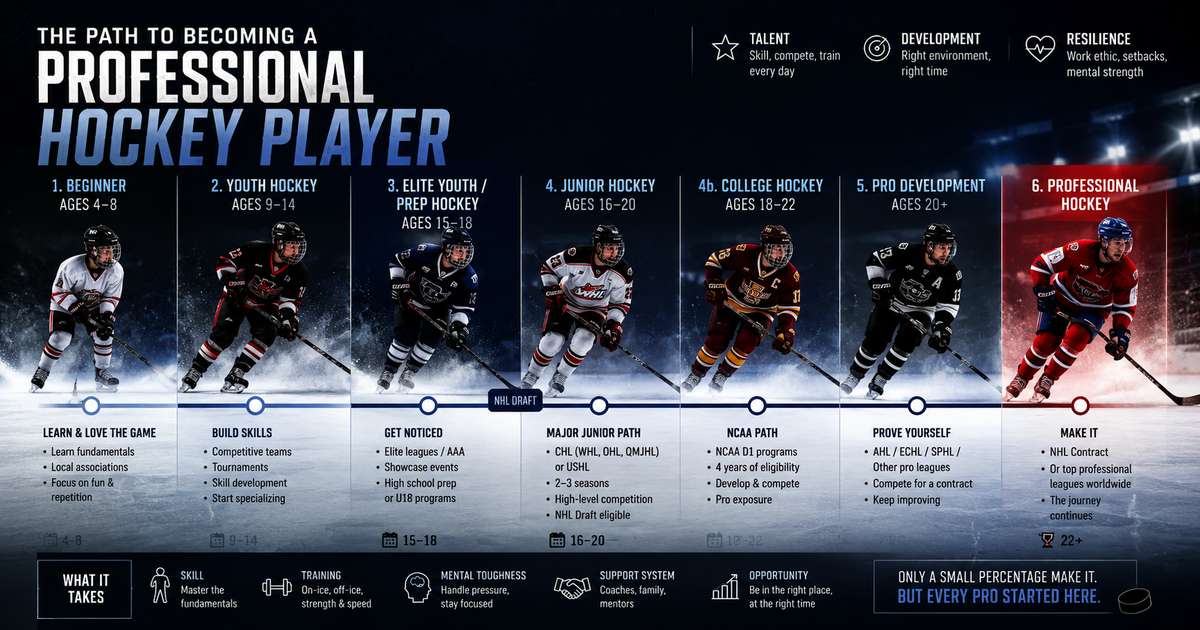
Yes—you can trace a realistic route from youth hockey to a professional contract, but the path is a ladder with distinct stages, trade-offs and visibility gates. The short answer: begin in learn‑to‑play and age‑based minor hockey, progress into competitive travel/AA/AAA U16–U18 levels, choose a junior or college route that preserves recruitment options, then move to minor professional leagues (AHL/ECHL) or sign an NHL entry‑level deal when teams select and sign you.
That summary is accurate but incomplete: each stage changes what scouts, coaches and teams actually evaluate, and important choices—major junior versus NCAA-eligible junior, where you play at 16–20, and whether you enter the CHL or USHL—shape visibility and eligibility for drafts and contracts.
Quick answer
The development ladder runs: learn‑to‑play → age‑based minor hockey → competitive travel/AA/AAA → junior hockey (CHL/USHL/Junior A) or NCAA pathway → minor pro (AHL/ECHL) → NHL entry‑level contract when an NHL club drafts and signs a prospect.
What this article explains
- Why CHL and USHL carry different implications for draft exposure and NCAA eligibility.
- How the AHL and ECHL function as development destinations after junior or college.
- Which decisions at junior age change the recruitment and contract options available later.
What the question really means: one ladder, many choices
Asking how to become a professional hockey player is really asking how to navigate a staged development model that most national federations describe: start in learn‑to‑play, then age‑based minor hockey, move into competitive levels (AA/AAA/Bantam/U18), then into junior or college paths that lead to professional opportunities. The pathway is not a single straight line—national programs and leagues offer alternative routes depending on the country, player age and eligibility choices.
The early direct answer: the ladder you will follow
Use the staged model as your short roadmap. Begin with learn‑to‑play and organized minor hockey, rise through competitive youth levels, then enter junior hockey (major junior CHL in Canada or top U.S. junior leagues like the USHL) or maintain NCAA eligibility via non‑major‑junior routes (Junior A, USHL, BCHL and similar). After junior or college, players typically enter minor professional leagues (AHL and ECHL) while NHL clubs decide on drafting and signing prospects to entry‑level contracts.
Skating and game‑skill foundations scouts want first
National development models emphasise age‑appropriate skill progression: by the time a player moves into competitive AA/AAA or Bantam/U18 levels, skating mechanics, edge control and game awareness must support puck skills. Evaluators at junior and college levels look for players whose skating and decision‑making hold up in full games; development models guide practices toward those outcomes rather than isolated tricks.
Major junior (CHL) vs college and other junior choices: what changes
The CHL (WHL, OHL, QMJHL) is the primary major‑junior route in Canada for roughly 16–20‑year‑olds and offers wide exposure to NHL scouts; CHL players are eligible for the NHL Entry Draft and many go on to sign entry‑level contracts or be assigned to AHL affiliates after signing. By contrast, playing in major junior historically affected NCAA eligibility, so players who want to keep the college route typically play in non‑major‑junior leagues (USHL, Junior A leagues such as BCHL) which are common recruitment pools for NCAA Division I.
How scouts, the NHL Entry Draft and exposure fit into the ladder
The NHL Entry Draft is a key mechanism for clubs to acquire prospects; drafted players may be signed to entry‑level contracts and then either kept in junior/college or assigned to an affiliate in the AHL/ECHL. Leagues and teams create identification events—CHL prospects events, USHL tryouts and national development programs—that provide systematic exposure to scouts and college recruiters. Where you play at junior age matters for visibility and the timing of contract decisions.
Minor professional leagues and the first pro steps
After junior or college, the American Hockey League (AHL) and the ECHL are the primary professional environments where players continue development. NHL clubs commonly assign signed prospects to the AHL; unsigned players also pursue pro careers in the AHL and ECHL. These leagues function as the bridge between amateur/junior competition and NHL readiness—teams monitor players’ adaptation to full professional schedules, systems and physical demands.
Hidden constraints and decisive decision points
Several decisions carry long‑term consequences. Choosing CHL major junior gives broad scout exposure but has historically impacted NCAA eligibility; choosing USHL or Junior A makes NCAA recruitment more likely. National federations’ staged models and league rules shape these choices—so do team needs, roster spots and the timing of the NHL Entry Draft. Identification events matter because they concentrate scout attention; conversely, remaining in lower‑visibility leagues can delay or limit professional opportunities even for skilled players.
Translating this into a realistic pathway
Follow the staged model used by Hockey Canada and USA Hockey: develop through learn‑to‑play and age‑group minor hockey, seek competitive AA/AAA opportunities as you mature, then choose a junior route aligned with your goals—major junior for broad CHL exposure and draft visibility, or non‑major‑junior (USHL/Junior A) to preserve NCAA eligibility. Use identification events, national development programs and league tryouts to gain exposure. After junior or NCAA hockey, aim for professional opportunities in the AHL or ECHL while teams evaluate prospects for NHL entry‑level contracts.
Final verdict: realistic, conditional—and structured
Becoming a professional hockey player is a realistic outcome for a small portion of players who successfully navigate the staged development model and competitive choices. The route is structured: learn‑to‑play → minor hockey → competitive youth levels → junior or college routes that shape visibility and eligibility → minor pro → possible NHL entry‑level contract. Your choices at the junior and college decision points matter for exposure and eligibility; identification events and league performance are where scouts and clubs make their judgements.
Author: Cynthia D.