Bobby Orr: How a Brief Career Redefined the Offensive Defenseman
Bobby Orr transformed what teams expected from a defenseman. In a career that began in the NHL in 1966 and, despite chronic knee damage, delivered two Stanley Cups and a string of individual dominance, Orr rewrote positional play and left a legacy disproportionate to the seasons he was able to complete.
Editorial summary
Bobby Orr rose from Parry Sound to become the first defenseman to win the NHL scoring title, collected multiple MVPs and Norris Trophies, and anchored two Bruins Stanley Cup championships before chronic knee injuries truncated a career of singular impact.
What you will learn here
- Key stages of Orr’s career from his debut through his final seasons.
- Why his play fundamentally changed the defenseman role, supported by awards and scoring achievements.
- How injuries shaped the arc and how his legacy is measured today.
EARLY ROOTS AND FIRST HOCKEY DEVELOPMENT
Bobby Orr was born on March 20, 1948, in Parry Sound, Ontario. That origin is more than biographical detail: it anchors the start of a trajectory that brought a small-town player into the NHL landscape in the mid-1960s. His early move into professional hockey led to an NHL debut in the 1966–67 season when he immediately announced himself as a rookie of note.
THE PATH INTO HIGHER-LEVEL COMPETITION
Orr’s transition into the NHL was rapid by any era’s standards. He won the Calder Trophy as the league’s top rookie for the 1966–67 season, marking the first formal recognition that his game translated at the highest level. That early award foreshadowed a player who would not only adapt to the NHL but change how the position functioned within it.
THE FIRST YEARS THAT MADE PEOPLE NOTICE
Within a few seasons of his debut, Orr had become the fulcrum of his team’s offence from the back end. His first Norris Trophy—awarded to the NHL’s best defenseman—arrived early and was the beginning of a run of dominance. Those seasons established him not as an occasional offensive defenseman but as a consistent, award-winning force.
THE ERA OR TEAM THAT DEFINED THE PLAYER
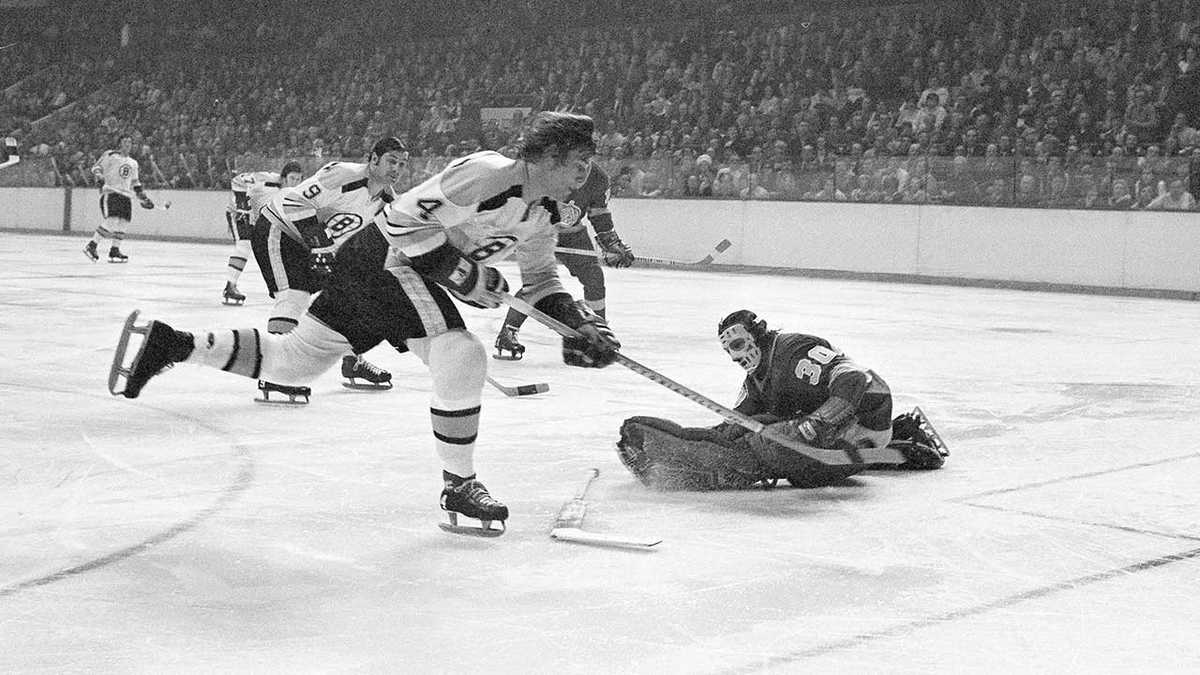
Orr’s prime seasons came with the Boston Bruins, a period that included the franchise’s two Stanley Cup championships in 1970 and 1972. The 1969–70 season was particularly defining: Orr swept the major awards available to him by winning the Art Ross Trophy (NHL scoring), the Hart Memorial Trophy (league MVP), the Norris Trophy (best defenseman), and the Conn Smythe Trophy (playoff MVP) in a single season. That sweep — rare by any measure — tied his individual peak directly to team success and remains a central reason his name is invoked when discussing transformational seasons.
STYLE OF PLAY AND ON-ICE IDENTITY
Orr redefined the defenseman role by turning it into a genuine two-way—or rather two-ended—responsibility. He became the first defenseman ever to lead the NHL in scoring, taking the Art Ross Trophy in 1969–70 and again in 1974–75. That distinction—the only time a defenseman has led the league in points—encapsulates the technical innovation he brought: sustained offensive creation from a position previously judged primarily on defence and board work.
RIVALRIES, TEAMMATES, AND DEFINING RELATIONSHIPS
Orr’s career is inseparable from the Bruins teams he led to championships. His peak seasons coincided with franchise success, tying his individual awards to team outcomes. While exact roster and rivalry details go beyond the verified facts used here, the simple alignment of his personal awards with Stanley Cup victories shows a player whose relationships on-ice produced decisive results in key seasons.

SETBACKS, INJURIES, OR CAREER RESETS
The durable throughline of Orr’s story is also its rupture: chronic knee injuries, particularly affecting his left knee, severely limited his availability from the mid-1970s onward. Those injuries reduced his games played in multiple seasons and were the proximate cause of an early retirement; while his NHL career technically spans from the 1966–67 season through parts of the 1978–79 season, the latter years were marked by physical decline and limited playing time.
THE MOMENTS THAT FIXED THE LEGEND
Cementing moments matter in legacy building. Orr’s overtime goal that clinched the 1970 Stanley Cup is a documented, iconic moment: an image and event commemorated widely and remembered as a defining instant in both his career and Bruins history. Combined with award sweeps (notably 1969–70) and his unprecedented scoring titles as a defenseman, those moments convert statistical dominance into lasting cultural memory.
HOW BOBBY ORR IS VIEWED TODAY
Orr’s post-retirement recognition reflects the scale of his impact. He was inducted into the Hockey Hall of Fame in 1979 immediately after retiring; the Hall waived the usual three-year waiting period, a procedural exception that signals exceptional career significance. Statistically, his career totals—657 regular-season games, 270 goals and 645 assists for 915 points—underline how productive he was when able to play. The awards ledger—eight consecutive Norris Trophies, three straight Hart Trophies, two Art Ross titles, multiple All-NHL recognitions implied by those awards, and two Stanley Cups—provides the evidence base for his reputation.
WHAT THIS CAREER REVEALS ABOUT HOCKEY
Bobby Orr’s arc demonstrates how a player can alter positional expectations and how peak excellence can outweigh sheer longevity in shaping legacy. His statistical milestones—the only defenseman to win the Art Ross Trophy, eight straight Norris Trophies, and the rare season sweep of scoring, MVP and playoff MVP—are the concrete reasons his career is treated as revolutionary. At the same time, his story is a reminder that injuries can truncate influence: the physical limits that forced Orr away from the ice early also freeze a peak in sharp relief, allowing historians to examine both what he achieved and what might have been.
Quick answer
Bobby Orr changed how defensemen play by combining sustained offensive output with defensive responsibilities; his awards, scoring titles, two Stanley Cups and Hall of Fame induction — all achieved before chronic knee problems ended his career — are the concrete pillars of his legend.
Author: Eric M.